
Blog
Miles Davis and John Coltrane: Two Club Posters
Nov
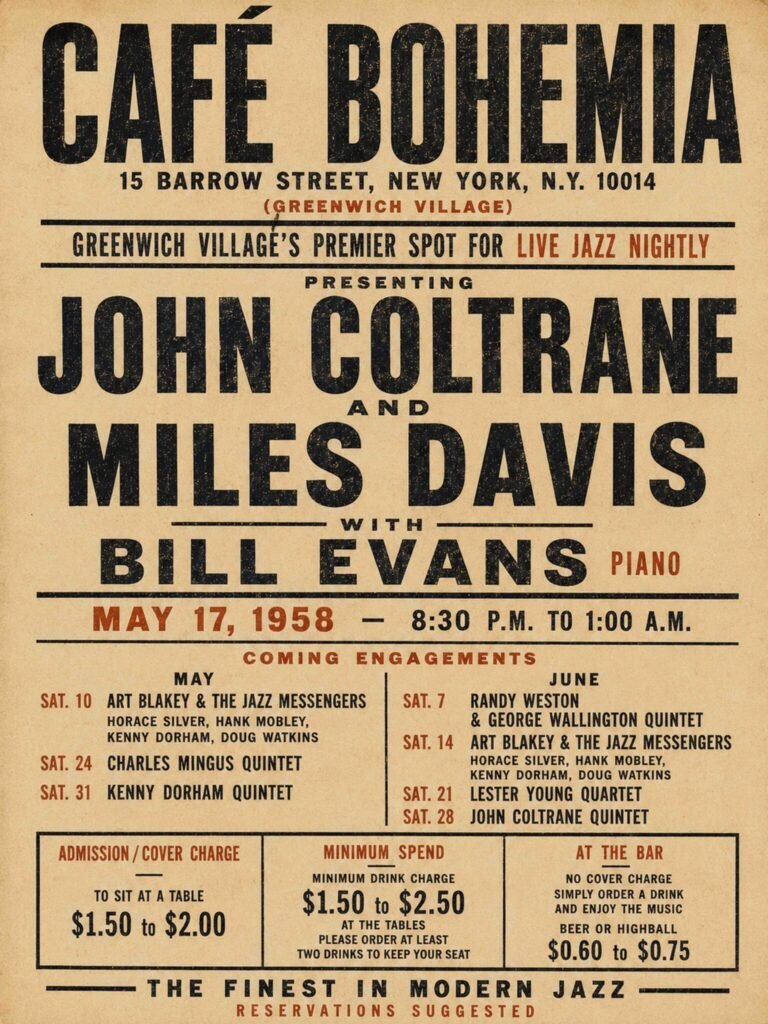
Miles Davis and John Coltrane made music together, but a Miles Davis John Coltrane concert poster presents a different kind of evidence: a promise, or an image of one, rather than a recording of what happened.
Two catalogue listings connect their names with Café Bohemia and Shelly’s Manne-Hole. Read closely, they reveal as much about the limits of poster evidence as they do about the appeal of jazz clubs.
Café Bohemia and the question of the bill
The first listing is titled John Coltrane Miles Davis Poster 1958 Café Bohemia Jazz. Its title brings a club, a year and two musicians into the same line, but the product details do not explain their relationship on the advertised occasion.
Was it a single engagement, a bill with separate acts, or artwork that brings familiar names together in another context? The listing does not say. The Café Bohemia jazz poster is therefore a starting point for an investigation rather than proof of a particular night.
That distinction matters because Davis and Coltrane did have a substantial musical relationship. Coltrane played in Davis’s band, and both appear on Kind of Blue, the 1959 album that became central to the story of modern jazz. A real collaboration, though, cannot authenticate every image that pairs their names.

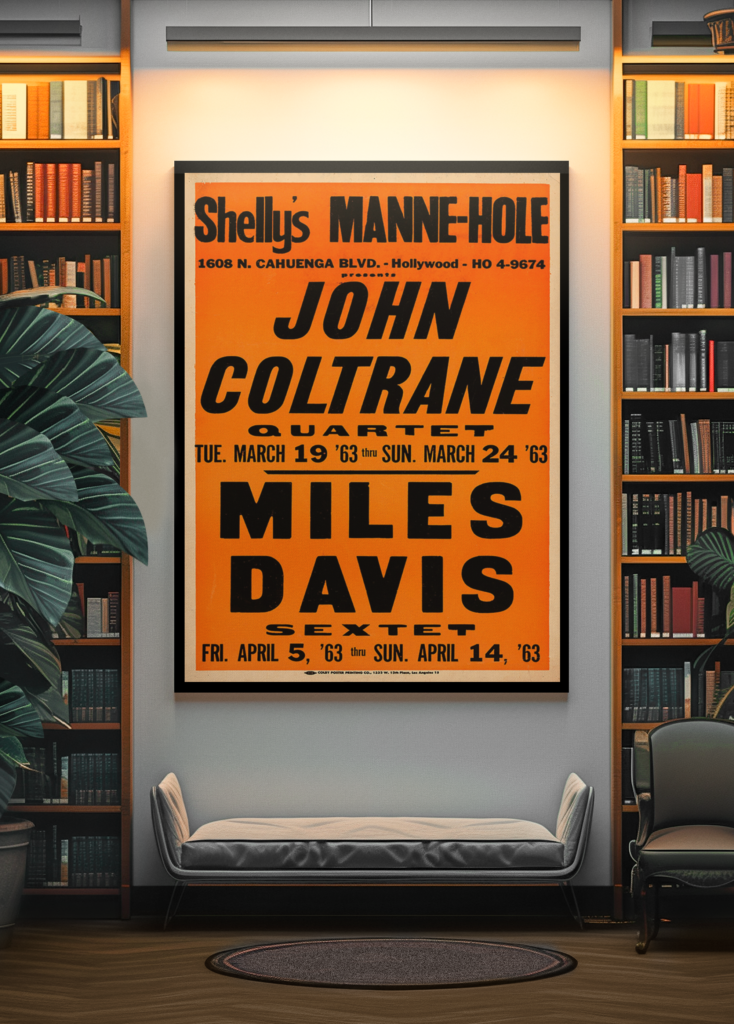
What the Shelly’s Manne-Hole title leaves open
The second listing, the Shelly’s Manne-Hole concert poster, carries a 1963 label alongside both musicians’ names. It offers a different club setting and a later catalogue date, but its description does not establish who performed, whether the musicians shared a bill or what occasion the artwork originally represented.
Placed beside the Café Bohemia listing, it suggests a sequence: one title points to 1958, the other to 1963. Those are dates attached to the products, not a verified itinerary. Without independent evidence for each image, the gap between them cannot be turned into a story of two documented club appearances.
The musicians’ careers did move in different directions. Coltrane led his own groups as well as working with Davis, so the presence of both names should prompt a question about roles, not an assumption that the same band appeared at both venues.
How a club poster becomes evidence
A club name does more than provide an address. In an advertisement it can evoke a particular room and its audience, while the musicians’ names give a prospective listener an immediate reason to pay attention. A date, if it belongs to the original engagement, anchors that invitation in time.
But titles and images can circulate long after an advertised performance, and a reproduction’s listing is not the same thing as an event record. For these two works, the supplied descriptions do not identify the designers or explain the original event contexts. They also do not give enough detail to compare the posters’ typography or imagery responsibly.
A stronger account would match each work against a dated advertisement, venue record or other contemporary evidence. That could clarify whether the names denote performers together, separate attractions or something else entirely.
Two voices beyond the poster
The appeal of the pairing is nevertheless clear in the music. Davis’s trumpet and Coltrane’s tenor saxophone brought distinct voices into the same ensemble: one could favour space and restraint, while the other could pursue a line with gathering intensity. That contrast is a useful way to listen, rather than a rule that describes every solo either man played.
Their recordings make the partnership audible; the two catalogue listings raise a separate visual question about how jazz names and venues are presented. The jazz icons collection places these works among other artist-led poster subjects, but the history of each image still needs to be established on its own terms.
Shop the collection
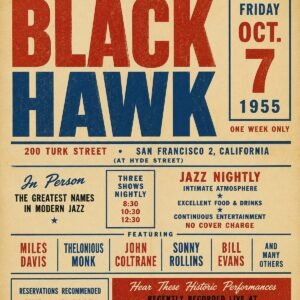
 San Francisco Black Hawk Jazz Night Live Music Poster 1955 Price range: $5.50 through $230.00
- Ella Fitzgerald & Count Basie 1970 Concert Poster Price range: $5.50 through $230.00
- Benny Goodman 1958 Munich Concert Poster Price range: $5.50 through $230.00
- Ella Fitzgerald Dizzy Gillespie Oscar Peterson Jazz Concert Poster 1956 Price range: $5.50 through $230.00


Frequently asked questions
Did Miles Davis and John Coltrane play together?
Yes. Coltrane played in Davis’s band, and both musicians appear on the album Kind of Blue. The catalogue titles alone do not establish the events behind the two posters.
Do the two posters document a shared bill?
The listings name both musicians, but the supplied product details do not establish whether either image advertised a shared performance or a particular engagement.
Explore jazz poster artwork
Explore jazz artwork and other concert posters in the PulpPoster collection.