
Blog
Paris 1937: Art Deco’s Modern World on Paper
Nov
In 1937, Paris hosted an international exposition in a city whose skyline already included the Eiffel Tower. Architecture and display offered visitors ways to encounter ideas of modern life at a public scale.
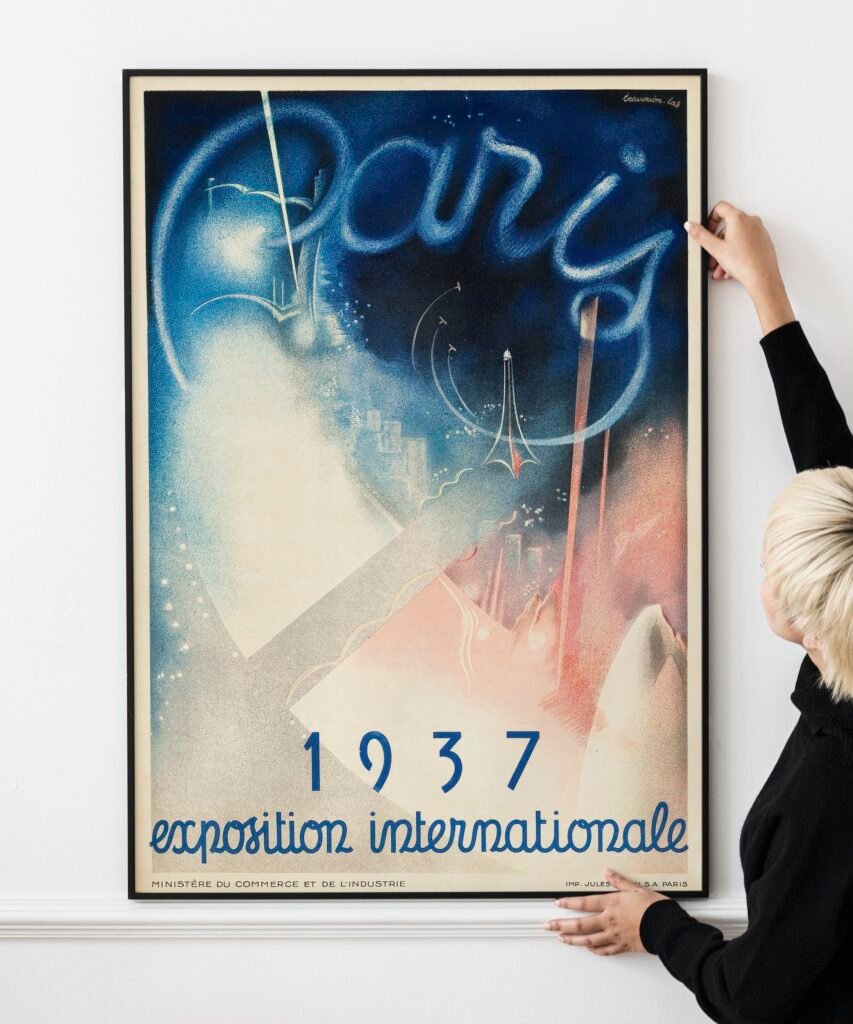
The 1937 Paris exposition Art Deco poster invites a related question: how can a single image evoke an event made of buildings, objects and movement? The answer lies in the possibilities and limits of graphic design.
An exhibition built to be seen
International exhibitions brought buildings, objects and visitors together in a setting designed to be walked through. Their pavilions did more than provide shelter: they offered participating countries a way to present themselves through architecture and display.
Paris supplied a setting already associated with monumental architecture. Against that backdrop, the exposition made the temporary exhibition building part of a larger conversation about what a modern city could look like.
A poster had a different task. Where a visitor could move between buildings and discover details at full scale, a sheet of paper had to create an impression at a glance. Its composition could suggest the character of an event without reproducing the experience of being there.
When architecture becomes graphic design
Art Deco is associated with an interest in geometry, stylisation and carefully ordered decoration. It could borrow the rhythms of architecture while reducing them to shapes suited to print: strong verticals, repeated forms and emphatic lettering.
That shared vocabulary helps explain why posters and buildings of the period can feel related even when they use different materials. Both organise space, direct the eye and make an argument about what deserves attention.
The relationship is not a simple matter of copying a façade onto paper. A graphic designer can compress distance, alter scale and place words alongside images. On a poster, the name of a place or event can become as much a visual feature as an illustrated building.
What the catalogue poster can tell us
The catalogue’s Art Deco International Exposition Paris Poster 1937 offers a way into that meeting of exhibition culture and graphic design. The listing identifies it as a reproduction, but does not establish the artist, original purpose or specific imagery of the source work.
Those gaps matter. Without a reliable identification, it would be easy to mistake a particular shape for a known pavilion, or to read a symbol as evidence of an intention the artist never recorded.
Looking closely still has value. Consider how lettering, colour, scale and the arrangement of forms establish a hierarchy on the page. These are questions about visual effect, not proof of what the original designer meant. They allow the poster to be discussed without turning an attractive interpretation into an invented history.
A modern world condensed onto paper
Exposition posters belonged to a wider world of public graphics competing for attention in streets, stations and other busy places. Historical advertising posters often used a similarly economical visual language, bringing a subject and a message together in a single composition.
French travel posters provide another useful comparison. They could make a destination recognisable and desirable through a selective view, rather than attempt to show everything a traveller might encounter.
The distinction matters: an exhibition is an event, a city is a place, and a poster is an interpretation of either. Seen today, such images preserve not just subjects but choices about how to present them. Their lasting interest lies partly in that distance between the complex world and the crisp image offered to a passer-by.
Shop the collection
 La Corne D’Or 1930s French Travel Poster – Paris Lyon Méditerranée Railway, Vintage Art Deco Scenic Wall Print Price range: $5.50 through $230.00

Frequently asked questions
Who designed the Paris 1937 exposition poster?
The designer of the particular work represented in the PulpPoster catalogue has not been confirmed.
Was Art Deco used only for posters?
No. Art Deco appeared across architecture, interiors, furniture, objects and graphic design.
Explore the poster collection
Explore posters that bring together travel, advertising and graphic design history.