
Blog
The Art of Keeping Alien’s Monster Out of Sight

Nov
A glowing crack in an egg, surrounded by darkness: one of Alien’s best-known poster images makes danger visible without showing the monster. The Alien 1979 Japanese movie poster belongs to a wider visual story about how the film was presented to audiences.
That story is also about restraint. On screen and in the familiar egg artwork, uncertainty can be more compelling than a full view of the creature.

A spaceship full of places to hide
Alien takes a familiar adventure setting, a spacecraft far from home, and makes its enclosed rooms and passages feel exposed. The crew cannot simply leave the danger behind. The ship offers places to work, eat and sleep, but also places where something might be waiting.
Suspense comes from the gap between knowing there is a threat and knowing where it is. A corridor can be empty in the immediate sense yet still feel occupied by possibility. The audience searches the image for signs, and that act of looking becomes part of the tension.
The creature is glimpsed rather than continuously displayed. Its body can register as a fragment before the viewer has time to understand the whole, making it harder to judge its shape or anticipate its movement.

The egg and the space around it
One familiar Alien campaign design reduces the danger to an egg against a dark background. Light spills from a break in its shell, but the image does not show the adult creature. The eye is drawn to the bright opening, then left to imagine what might emerge.
The darkness around the egg matters as much as the object itself. It isolates the form and gives the small fracture room to command attention. There is little else to inspect, so the viewer returns to the same unresolved question: what has made that opening, and what comes next?
This is negative space doing more than tidying a composition. The surrounding dark becomes a visual equivalent of the film’s withheld information. It cannot tell us where the danger is, but it gives the imagination somewhere to put it.
What a Japanese poster can tell us
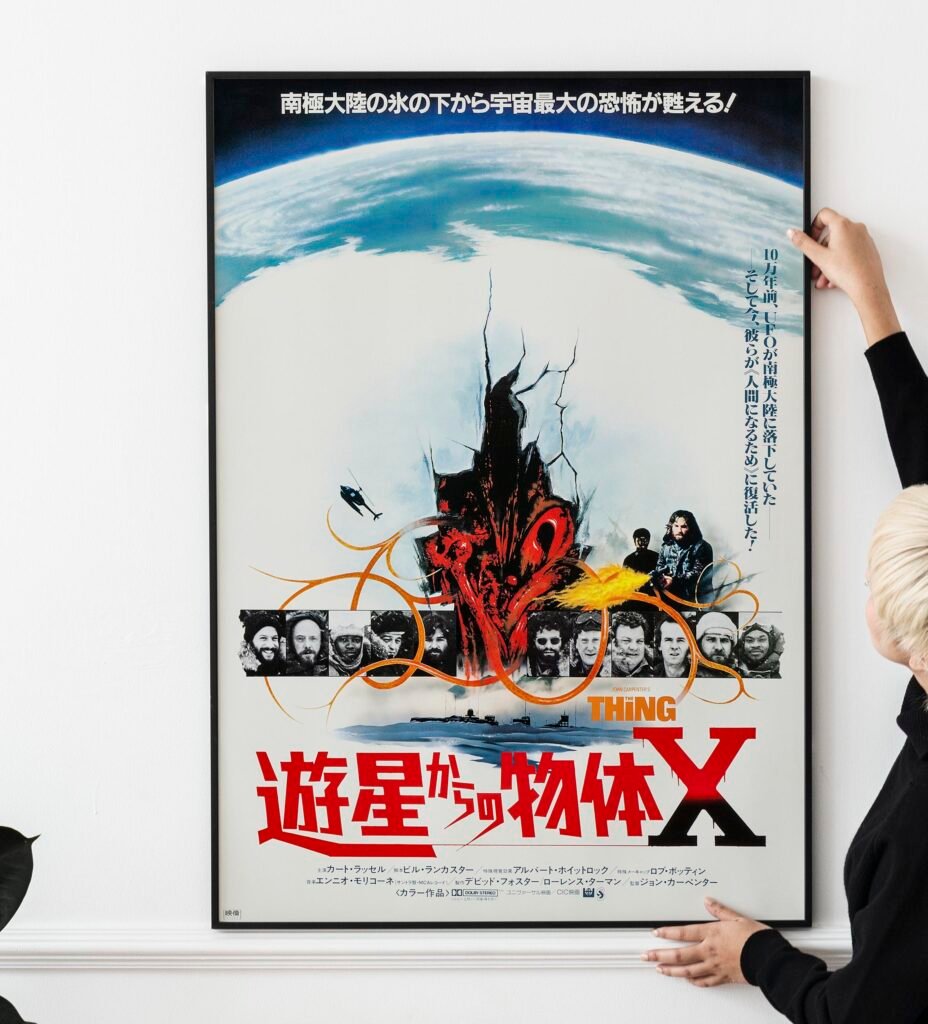
The catalogue lists an Alien 1979 Japanese movie poster as a reproduction, offering a Japanese poster to consider alongside the better-known egg campaign. Its listing does not describe the image or name its designer. Without those details, it would be misleading to claim exactly what the Japanese artwork shows or how closely it follows another campaign.
That distinction matters because posters made for different markets need not use the same imagery or have the same creators. A shared film title is not evidence of a shared design process. Even when two posters suggest a similar atmosphere, resemblance alone cannot establish who made them or what they intended.
The useful comparison begins with what can be seen in each image: what occupies the foreground, how much space surrounds it and whether the threat is visible. Those choices can be discussed without treating one poster as a copy of another.
When a threat becomes an image
A monster poster does not need to conceal its subject to be effective. Showing a creature can promise scale, spectacle or a confrontation; withholding it offers a different invitation. The audience supplies an image of its own, which may be more alarming precisely because it is unfinished.
Alien’s egg design makes that uncertainty unusually compact. The poster offers an object, a rupture and a dark field, enough to suggest that something is about to happen without settling what it will look like. Its power lies in the distance between a clue and an answer.
For a wider look at how films present danger, the movie poster collection and vintage horror movie posters offer other points of comparison. Each can be read for the same balance between what an image reveals and what it leaves outside the frame.
Shop the collection
 Attack of the Crab Monsters 1950s Retro Horror Movie Classic Poster B-Movie Horror Poster Price range: $5.50 through $230.00
- House of Frankenstein 1944 Movie Poster Price range: $5.50 through $230.00
- Frankenstein Meets the Space Monster Curse of the Voodoo Combo 1965 Movie Poster Price range: $5.50 through $230.00
- Godzilla Kaiju Alternative Japanese Movie Poster Price range: $5.50 through $230.00


Frequently asked questions
Does the Alien egg poster show the monster?
The familiar egg design suggests a dangerous birth rather than showing the adult creature. Its glow gives the viewer a clue without explaining what is inside.
Who designed the Japanese Alien poster?
The supplied catalogue details do not identify a designer, so an attribution would need to be verified separately.
Explore more movie posters
Explore film artwork and horror imagery in the PulpPoster collection.