
Blog
The Doors on the Sunset Strip: A Scene in Posters

Nov
The Doors Whisky a Go Go concert poster brings two names together: a Los Angeles band and a club on the Sunset Strip. The pairing evokes the city’s 1960s nightlife, when live music and the places that hosted it became inseparable in the popular imagination.
The catalogue artwork offers a starting point for exploring that connection, and for asking what a concert poster can tell us about a scene.
A club name with a Los Angeles address
The Sunset Strip was part of a Los Angeles music culture in which nightclubs gave bands a place to meet an audience face to face. The Whisky a Go Go became one of the names associated with that culture, and The Doors with the city’s rock scene.
A club name on a poster does more than tell an audience where to go. It places a performance within a particular social world: the streets around the venue, the people who know its name and the anticipation of a night out. Long after the occasion has passed, that address can carry as much atmosphere as the band’s name.
The poster’s reference to the Whisky therefore offers a way into the story of the Strip. It should not, on its own, be treated as evidence of a particular appearance.

What the Doors poster can and cannot tell us
The shop lists the Doors Whisky-A-Go-Go poster as a psychedelic rock print and dates it to 1967 in its title. Those are useful catalogue details, but the supplied information does not establish the event date, the circumstances of the performance or the identity of the designer.
Psychedelic concert art is often associated with expressive lettering and a visual intensity that asks viewers to look closely. Such features can suggest an era and an audience without proving who made an individual image. Style is a clue to interpretation, not a signature.
There is a productive tension in that distinction. A poster can feel immediate, as though it belongs to a particular night, while leaving important questions unanswered. Reading it carefully means enjoying the atmosphere without filling those gaps with an imagined production story.
How a poster gives music a place
Concert posters have a practical job: to bring performers, venues and potential audiences together on a single surface. The result can also turn a venue into a kind of shorthand. A familiar club name suggests the character of a night before a listener has heard a note.
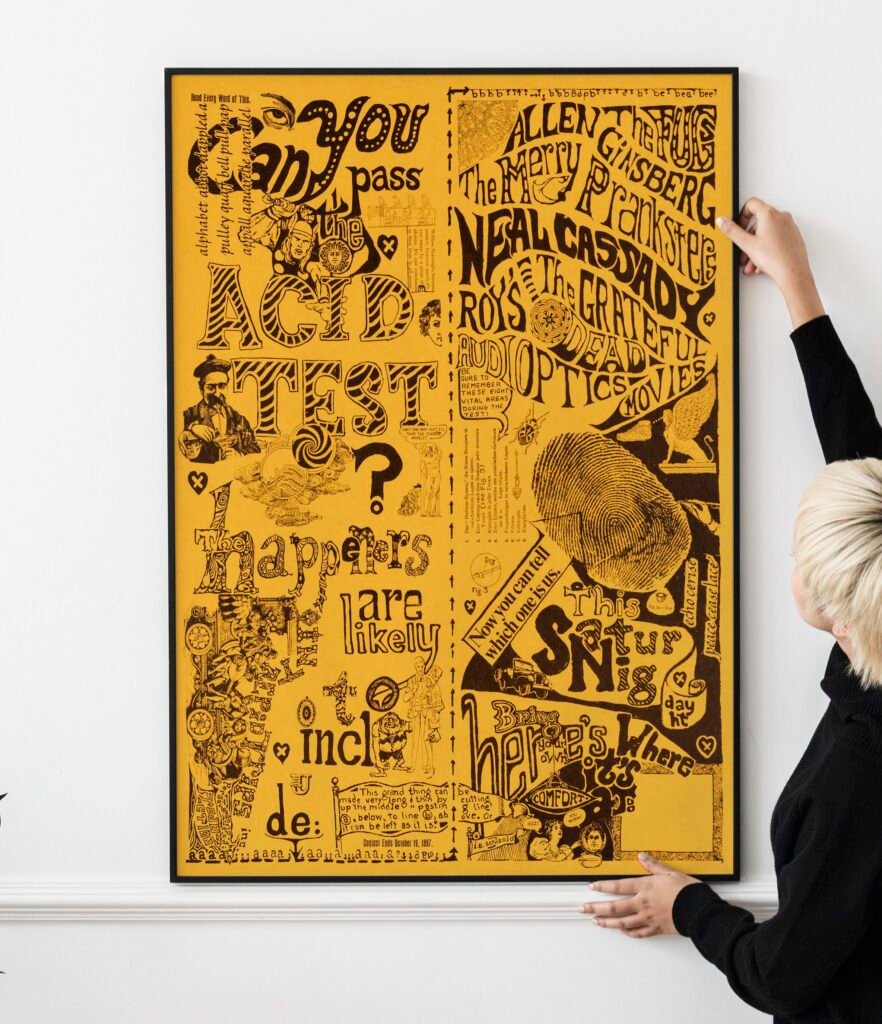
That sense of place is not confined to Los Angeles. The catalogue’s Grateful Dead Acid Test poster offers another route into the period’s music culture, with an event name that gives the band’s appearance a setting beyond the group alone. Its listing, too, is a starting point rather than proof of every detail of the event.
Looking across concert poster artwork, the names of performers and places often do different kinds of work. A band name draws attention; a venue or event name suggests the company, surroundings and expectations that might shape the experience.
The Strip after the night is over
The Doors poster’s appeal lies partly in that meeting of a band and a location. The Whisky name evokes the intimacy of a club, while the psychedelic description connects the image to a broader visual language of 1960s rock.
A reproduction can keep that association visible without settling questions about the original. Its subject invites a closer look at how music history is remembered: not just through recordings, but through the places and graphic imagery that come to surround them.
Shop the collection
 Velvet Underground and Andy Warhol 1966 Fillmore Auditorium Concert Poster Price range: $5.50 through $230.00
- "Toronto Rock n Roll Revival" 1969 Poster with John Lennon, Eric Clapton, The Doors Price range: $5.50 through $230.00
- Rare Dizzy Gillespie Retro Concert Poster – 1960s Jazz Festival, Trumpet Icon Price range: $5.50 through $230.00
- Dizzy Gillespie 1960s Jazz Poster – "Concert Under the Stars" Des Moines, Vintage Bebop Poster Art Price range: $5.50 through $230.00


Frequently asked questions
Who designed the Doors Whisky a Go Go poster?
The supplied catalogue details do not identify a designer. The artwork’s psychedelic style is not enough to establish an attribution.
Does the catalogue’s 1967 date confirm the event details?
No. The year appears in the product title, but the date and details of the event represented need independent verification.
Explore concert poster artwork
Explore concert artwork from the catalogue and discover more connections between music and place.