
Blog
The Blue Angel: Dietrich, Nightlife and a Screen Image
Nov
A schoolteacher enters a nightclub, and the boundaries of his respectable world begin to come apart. The Blue Angel made that encounter between authority and performance central to its drama.
The Blue Angel 1930 film poster offers a way into the film’s atmosphere and Marlene Dietrich’s emerging screen image, while raising a question about what a poster can tell us about the past.
A nightclub against the classroom
Before it was a screen image, cabaret was a way of gathering an audience: a room, a stage and performers close enough to meet the spectators’ gaze. Berlin’s nightlife became closely associated with that culture, giving the city an enduring place in the popular imagination.
The Blue Angel draws on the charged atmosphere of a nightclub, where entertainment and social respectability meet uneasily. Its story follows a schoolteacher whose fascination with a performer unsettles his ordered life. The contrast between classroom and cabaret gives the film much of its tension: one world depends on authority, the other exposes how fragile it can be.
That setting should not be mistaken for a documentary record of Berlin nightlife. The nightclub is also a dramatic invention, a place where the film can make the act of looking feel consequential.
A voice and an image on screen
The Blue Angel belongs to the early era of sound cinema, when a performer’s voice could reach a film audience alongside their image. A nightclub setting made that possibility part of the drama: performance was no longer something cinema could show only through gesture and expression.
Dietrich’s presence helped the film travel beyond its immediate setting and introduced her to a wider audience. Her screen persona would come to suggest a distinctive combination of composure, ambiguity and theatrical display. Those qualities are open to interpretation, but they help explain why the image of the performer remained so compelling.
The film also turns the audience into part of its subject. The spectators inside the nightclub watch a performance; the cinema audience watches them watching. Desire and embarrassment are not confined to a private story but played out in public.
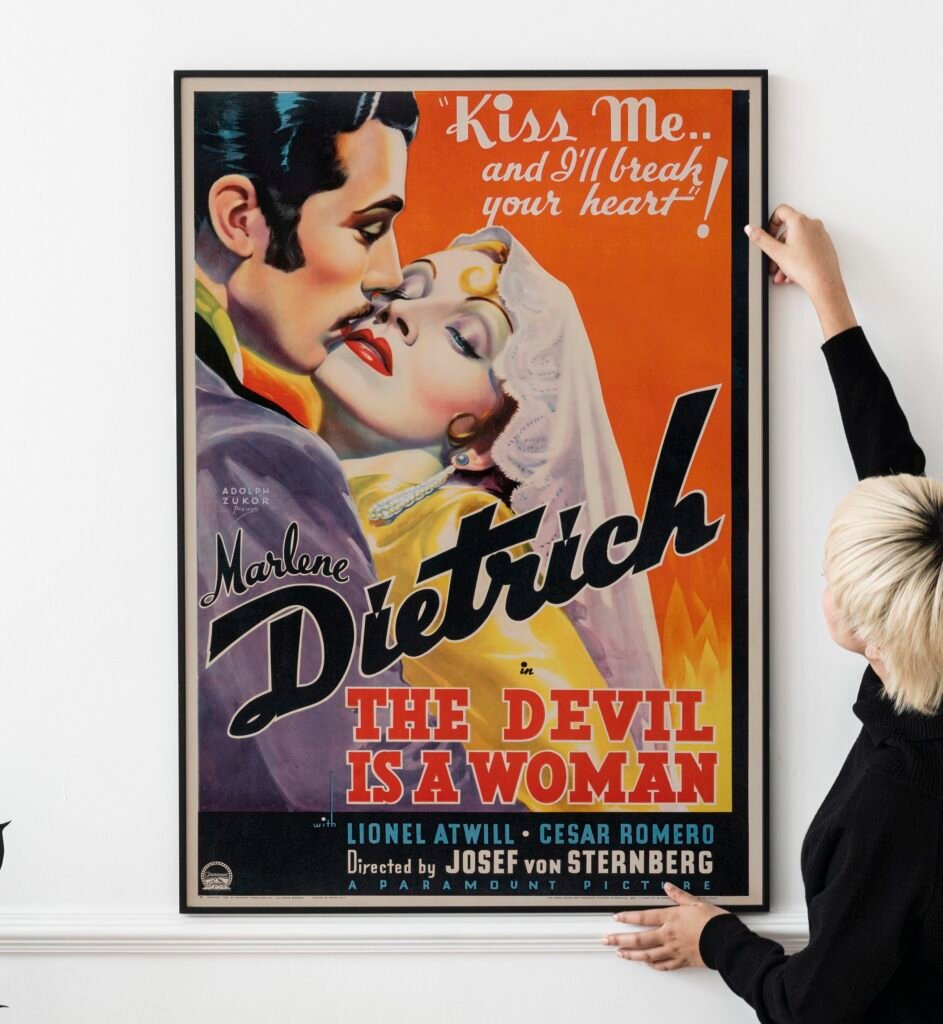
What the poster titles can tell us
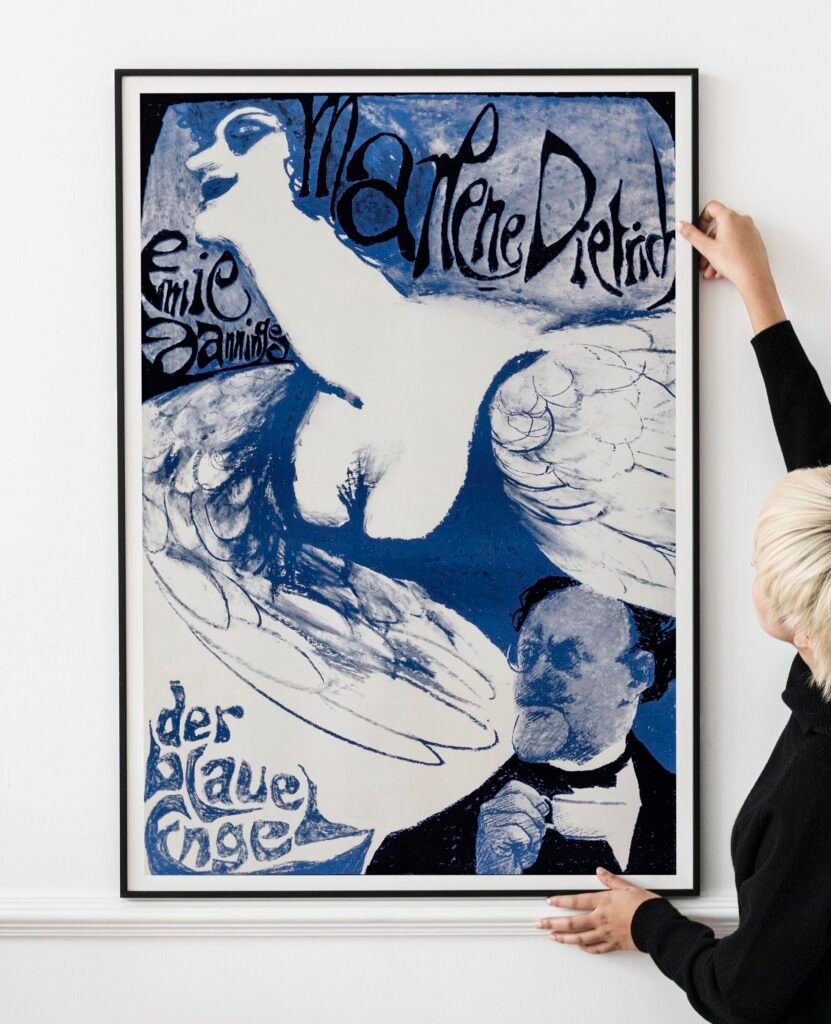
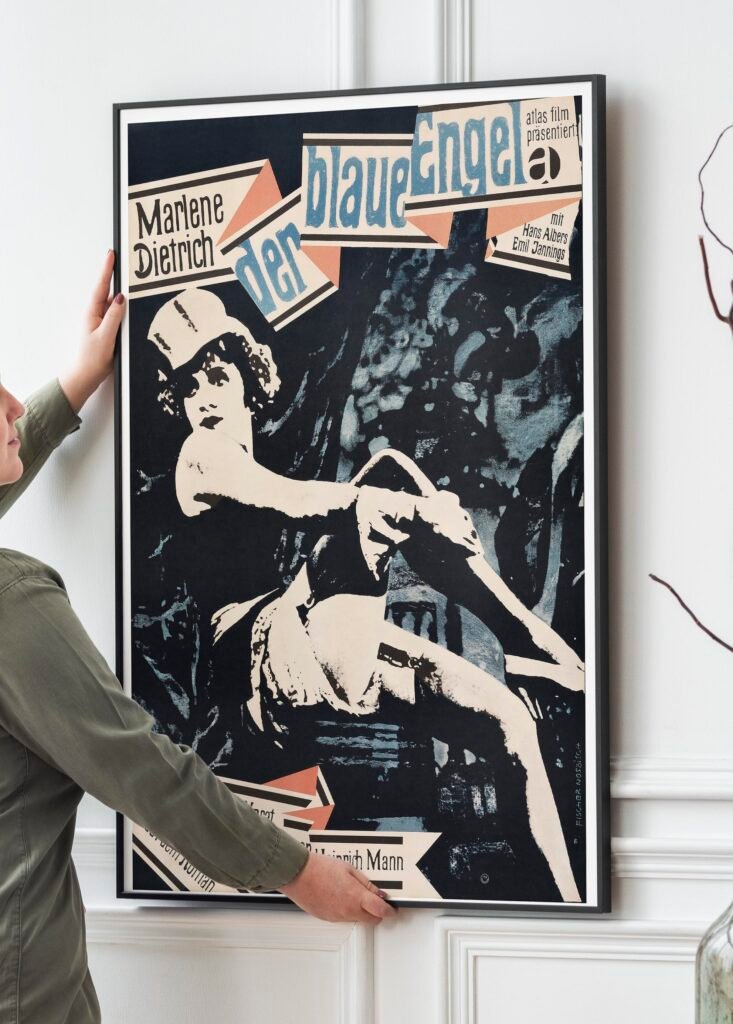
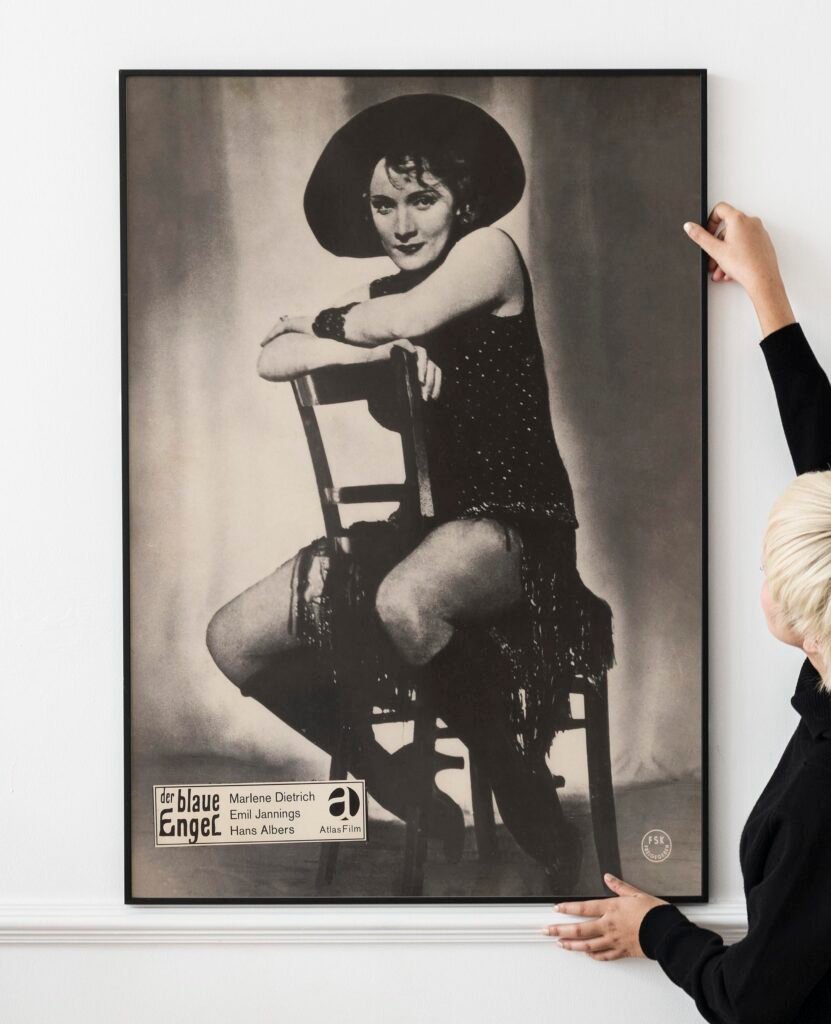
The catalogue’s Blue Angel movie poster puts Dietrich’s name alongside the film’s English title. That pairing is itself revealing: it presents the work through a star as well as a story, inviting a viewer to connect the film with the identity of its leading actress.
The catalogue also lists a Der blaue Engel movie poster, using the German title, and a Blue Angel publicity poster. Those labels offer different ways into the same subject: the film under another name, or Dietrich’s association with it as publicity. They do not, by themselves, establish when or where the designs were first used.
A close comparison with original advertising would require reliable examples of the historical campaigns. Without those references, it would be misleading to assign a designer, market or release context to the catalogue artwork, or to claim that a particular detail matches an original poster.
The performer beyond the film
Dietrich’s association with The Blue Angel has endured partly because the film makes performance itself so central. It is interested not just in a person on stage, but in the expectations that gather around her and the power an audience imagines it sees.
A poster has less room for such complications than a film. It must suggest a world at a glance, while a title and a familiar name carry associations beyond the image. Seen in that light, The Blue Angel’s poster history is also a story about how cinema condenses a performance into an invitation to look.
Shop the collection
 Gentlemen Prefer Blondes 1953 Iconic 1950s Comedy Film Poster with Jane Russell, Marilyn Monroe Price range: $5.50 through $230.00
- Marlene Dietrich 1930s Style Icon Movie Poster Price range: $5.50 through $230.00
- Marlene Dietrich in Angel 1937 Movie Poster Price range: $5.50 through $230.00
- Cabaret (1972) Liza Minelli Musical Movie Poster Price range: $5.50 through $230.00


Frequently asked questions
Is The Blue Angel set in Berlin?
The film draws on a world of German nightlife associated with the period, but its story should not be treated as a documentary portrait of Berlin.
What does Der blaue Engel mean?
It is the film’s German title and translates as The Blue Angel.
Explore more cinema artwork
Explore film posters and screen icons in the PulpPoster catalogue.