
Blog
Selling Speed and Reliability in Automotive Posters
Nov
A spark plug sits out of sight inside an engine; a motor race puts speed on public display. Vintage automotive advertising posters bring those two sides of motoring into the same visual conversation.
Looking at a Bosch component poster alongside artwork named for Brooklands, Monaco and Cuba reveals a useful distinction: selling a product and publicising a race are different jobs, even when both draw on the appeal of performance.

Making the hidden part visible
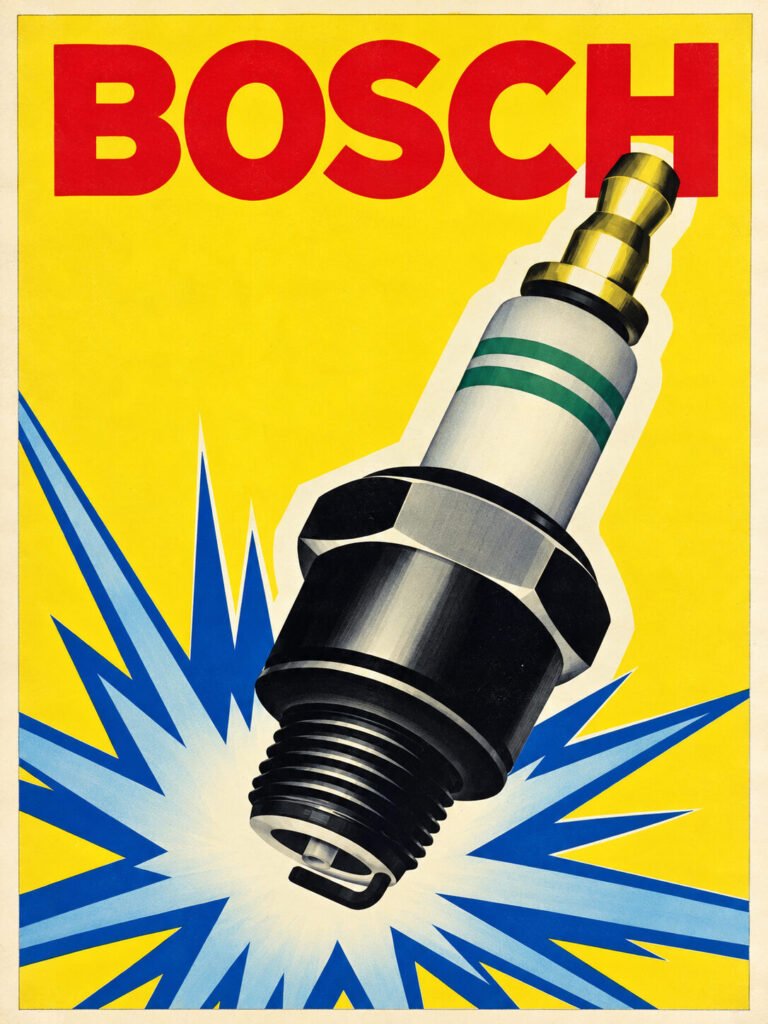
A spark plug is a small object with an important job: it ignites the fuel-and-air mixture in a petrol engine. An advertisement for one has to make a component, rather than the whole vehicle, worth noticing. The challenge is to turn an unglamorous piece of engineering into something recognisable and desirable.
The Bosch spark plug poster is listed as German automotive advertising. Its subject brings the practical side of motoring into focus: parts wear, engines need attention, and the appeal of a component lies in what it can do inside a machine as much as in what it looks like.
That makes product legibility central to the comparison. A brand name, the identity of the part and a suggestion of its purpose can give an advertisement its meaning even before a viewer knows anything about the car it might fit. Whether the original Bosch artwork made particular claims about reliability, however, requires a closer look at its text.

What a race name adds
A race poster has a different task. Rather than explaining a component, it can make an occasion memorable: a contest at a named place, with the promise of speed and uncertainty. The design has to suggest not only what motor racing is, but why this particular event matters.
The Brooklands 200 Miles Race poster names both a venue and a distance. Those words give the subject a specificity that a generic image of a fast car could not: they identify a contest rather than simply an idea of motoring.
Distance also changes the meaning of speed. A race is not only about a moment of acceleration; it suggests sustained performance and the possibility that cars and drivers will be tested over time. That tension makes endurance a useful counterpart to the reliability associated with automotive parts.
The catalogue does not establish when the Brooklands artwork was made or exactly how the original was used. It is therefore more revealing to compare its named subject with the Bosch poster than to assume the two addressed the same audience or belonged to the same campaign.

Grand Prix names and places
A race title can carry a sense of place as well as competition. The 1980 Monaco Grand Prix poster and the 1958 Cuban Grand Prix poster identify different settings and years in their catalogue titles. The Cuban listing also names the racing driver Juan Manuel Fangio, adding a person to the combination of event and location.
Those details offer different ways into the subject. Monaco and Cuba locate a race in the reader’s imagination; Fangio’s name gives the Cuban poster a human point of reference. A component advertisement, by contrast, can centre its identity on a product that works out of sight.
The titles alone do not tell us whether either Grand Prix design was originally an event promotion or a commercial advertisement. Nor do they establish when each artwork was produced. The distinction matters: a poster can refer to a famous race without necessarily having been commissioned to announce it.
Where machinery meets spectacle
Product advertising and race imagery meet around a shared idea: the car as a machine whose performance matters. They approach that idea from different angles. The part asks to be understood; the race offers a setting in which performance becomes visible.
That does not mean every automotive poster fits neatly into one category. A commercial design might borrow the excitement of competition, while artwork associated with a race might also carry a brand message. Establishing its original purpose is part of reading it, not a detail to be filled in from its subject.
Together, these catalogue titles span components, circuits, places and personalities. They show how much information can be carried by a few identifying words, while leaving room for further questions about the artwork behind them. The most interesting comparison is not simply between slow and fast, but between the machinery that makes motion possible and the public occasion that gives it drama.
Shop the collection
 World War II Propaganda Poster (U.S. Government Printing Office, 1942). Price range: $5.50 through $230.00
- 1968 Bonneville Salt Flats Racing Promotional Poster Price range: $5.50 through $230.00
- 1963 Bonneville Salt Flats Racing Promotional Poster Price range: $5.50 through $230.00
- Canadian WWII Propaganda Poster – Vintage Wartime Decor Price range: $5.50 through $230.00


Explore automotive poster art
Explore automotive advertising and motor racing artwork in the PulpPoster collection.

